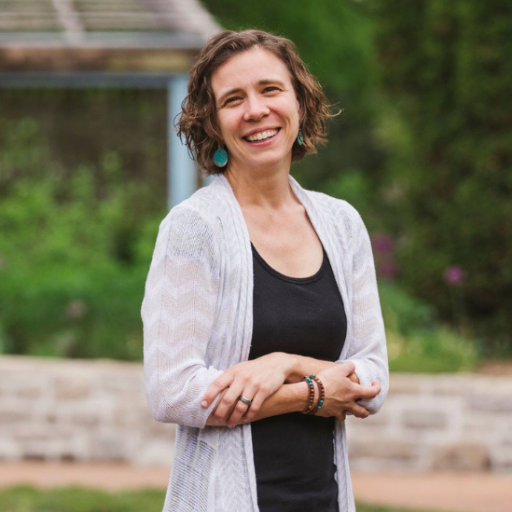
Exploring Sacred Ritual & Liminal Space: A Conversation with Tracee Stanley
There's a moment right before the sun breaks the horizon. Not night anymore, not quite day. If you've ever been awake for it, you know it has a texture all its own - hushed, suspended, full of something that has no name.
That's the place Tracee Stanley lives in. And after sitting with her in conversation for my podcast, I think it might be the place we're all quietly longing to return to.
Tracee is a yoga nidra teacher, the founder of Empowered Life Circle, and the bestselling author of Radiant Rest and The Luminous Self. Her newest book, Living Ritual, arrives this August - and from the moment we started talking, it was clear this wasn't going to be a conversation about doing more. It was going to be a conversation about noticing more.
The space between
Tracee calls it liminal space - the pause between an inhale and an exhale, the hush before sleep finally takes you, the in-between of any transition. She told me something that's been sitting with me ever since: doubt doesn't live there. Not in the threshold. Only in the after.
If that's true, then every transition we move through in a day - and there are so many - is a small invitation back to a doubtless place. We just have to remember to notice it's there.
Ritual doesn't require a retreat
I think so many of us hear "ritual" and picture candles, a quiet house, an hour we don't have. Tracee gently dismantled that for me. She's not living on a mountaintop, she said. She has aging parents. People who depend on her. A life that looks, in its shape, a lot like ours.
What she has instead are sandhyas - the sacred junctures of the day. Sunrise. Midday. Sunset. Small windows, a few minutes wide, that she's learned to meet with presence rather than rush through. How she wakes. How she drinks her tea. How she washes the dishes. None of it requires more time. It requires attention.
Your attention is not a renewable resource - at least not the way algorithms treat it
This is the part of our conversation I haven't stopped thinking about. Tracee named something I'd felt but never quite articulated: our attention is being commodified. Pulled, extracted, monetized. The algorithm doesn't want us spacious; it wants us scrolling.
Nature, she said, doesn't work that way. Nature gives. Nature sustains. And when we practice, even just noticing where our attention has wandered and gently calling it home, we're practicing reciprocity instead of extraction. We're choosing a relationship with our own energy instead of letting it be taken.
Soham: the mantra you're already breathing
If all of this feels like a lot to add to an already full life, Tracee offered the simplest doorway I've heard in a long time: So Hum. It's the sound your own breath is already making: so on the inhale, hum on the exhale. No new habit required. Just noticing what's already there.
Who am I - and who am I not
We circled back, again and again, to the question underneath every practice: Who am I? Tracee mentioned a teaching that flips it: Who am I not? She suggests this as a way of peeling back everything we've mistaken for ourselves until what's left is essential.
It struck me how close this is to the work I keep returning to in my own practice and in The Calming Ground: the idea that healing isn't about becoming someone new. It's about re-membering - gathering the scattered, forgotten parts of ourselves back into wholeness. Tracee's whole conversation, in a way, was an invitation into exactly that.
An invitation
You don't need a five-day retreat to begin. Perhaps you need a sunrise, a midday pause, a breath you let yourself actually feel.
Listen to the full conversation with Tracee and let me know - what's your sandhya? Where in your day does the sacred already have a doorway open?