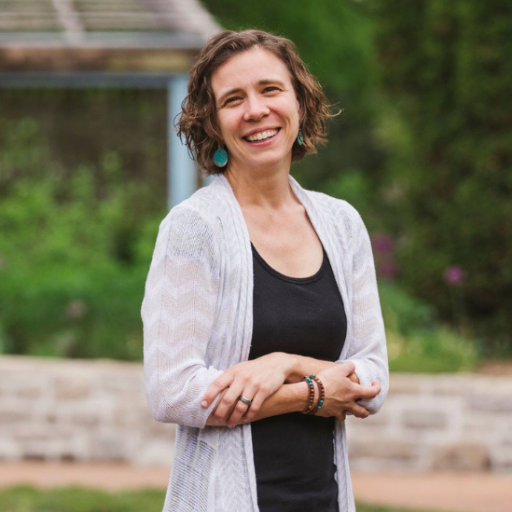
What It Means to Hold Nothing: A Conversation with Elena Brower
There are conversations that stay with you - not just because of what was said, but because of how they made you feel. My conversation with Elena Brower was one of those.
Elena is a yoga teacher of 27 years, a painter, a poet, a Zen practitioner and chaplaincy candidate, and the author of the forthcoming book Hold Nothing. She volunteers at a local hospice, teaches yoga and meditation to incarcerated men once a month, and works with families navigating loss and illness through an organization called Gerard's House. She is, as she said herself, someone who does many things… and somehow, each one flows from the same source.
That source, she told me, is what she calls Grandmother's Heart.
The Organizing Principle Behind Everything
When I asked Elena what part of her book felt most alive to her right now, she opened to Chapter 5 almost instinctively.
Grandmother's Heart.
"It's the organizing principle behind everything I'm doing these days," she said. "I'm just trying to carry a heart of compassion for everyone and everything… and it's really hard."
It's not a soft concept. It's an active, daily practice. When someone does something hurtful or confusing, Elena doesn't try to fix them or judge them. She tries to bring her grandmother's heart to it - to keep a sense of peace inside her own nervous system, so that steadiness might ripple outward.
Her teacher Roshi Joan Halifax puts it this way: Equanimity and grandmother's heart protect us, by giving us a base of support for the mass of our lives.
What moved me about this idea is how visual it is. "Compassion" is a concept. Grandmother's heart is an image, a felt sense, and it goes somewhere deeper than thinking.
Elena's own grandmother, Grandma Belle, is woven through the chapter. She described sitting at a tiny wrought iron table in her grandmother's kitchen as a child, a sesame bagel with cream cheese in front of her, The Price is Right on a television no bigger than her hand, her grandmother somewhere behind her, probably on the phone, probably smoking Benson and Hedges. "If you can remember the energy of being loved like that," she said, "in the ideal - that was that. And I know how lucky I am. That energy has carried me through a lot."
The Book That Needed to Be Rewritten
Hold Nothing was three years in the making, which wasn't the plan.
Elena handed in her first draft, and her editor sent it back. "I was trying to be all teachery and know-it-all," she said, laughing. "And really, what I needed to do was back up and teach nothing. Just tell my story."
So she got a small spiral notebook, and every time she sat down to meditate, she wrote whatever memory surfaced. The green grass in her childhood front yard. Yellow lines unfurling under her bike wheel. Sideways snowfall at Cornell. The streets of New York City beneath her feet.
"That's what this became," she said. "A series of those stories."
The teachings she had originally hoped to transmit - the ones that had genuinely helped her - they found their way in too, but at the end of each section, as questions and prompts for reflection. Not as a curriculum. As an invitation.
What I find so beautiful about that process is how it mirrors the very thing she's writing about. She thought she had something to hand over. What she was really being asked to do was let go of the version of herself that needed to teach, and trust the version that simply lived it.
Practice Invisibly. Work Intimately. Be the Fool with No Voice.
One of the most striking moments in our conversation came when Elena talked about an ancient Zen poem called Song of the Jewel Mirror Awareness - at least a thousand years old, from China, a foundational text in the Soto tradition she practices.
Her editor asked her to include it in the book. Elena had resisted, then relented. The reason it belongs there, she now understands, is in the final lines:
Practice invisibly. Work intimately. Be the fool with no voice.
"When I heard that for the first time," she said, "I thought: this is the end of me as I knew it."
She spoke honestly about how much of her life has been shaped by the hunger for recognition - the accolades, the validation, the achievement. "We were all raised in this society," she said. "Go, get the A! Good girl!" And she's been slowly, quietly working her way toward something else. Not disappearing, but retreating from the need to be seen in a particular way.
Interestingly, at the time of this interview, she was soon to be heading out on her book tour while holding that tension. She's going… and she's going as a student, not a teacher. "I can handle the thought of it now, because I'm going in to learn," she said. "I'm just gonna be in the chair at the front of the room, talking with whoever I'm speaking with - as the student."
There was something about hearing her say that out loud that gave me permission, too. To show up fully and hold it lightly. To offer something and remain open to what it might teach you.
Take Care
When I asked Elena if there was anything she most wanted listeners to receive, she paused. Then:
"I think one of the key teachings of Hold Nothing is just to be a really good friend. Take care of your body. Take care of your heart. Take care of your family."
She said the two words that kept coming to her were simply: take care.
"Holding nothing - letting go of all the things you thought you had to hold - will give you the space to do that in the way that is most appropriate."
We're in a time of a lot of divisiveness and fear, she acknowledged. And in moments like that, it's easy to feel like you need to do more, hold more, fix more. Her invitation is the opposite. Let go of what you've been gripping. And from that open space, take care.
Elena Brower's book Hold Nothing is available wherever books are sold. You can also find her teaching on Glow, and follow her work at elenabrower.com.